

What is new
Mr. Chidambaram, please look at the preach-practice deficit too!
- Published on 28 February 2014
 FM's Picture Courtesy PIB
Interim budget serves as a pedestal for the outgoing Finance Minister to pontificate. The urge to lay down the agenda for the future is more when the incumbent knows that the ruling party would not return to the power after the elections.
Mr. P. Chidambaram has thus rolled out a 10-point ‘A Vision for the Future’ in his 2014-15 budget speech. He perhaps aped Dr. Manmohan Singh, who had also unveiled his 10-point vision in the Interim Budget speech for 1996-97. Dr. Singh had labeled his vision as ‘medium term objectives for accelerated economic and social development’ over the next five years. After the elections, Dr. Singh had to sit on the opposition benches in Rajya Sabha.
Some of the objectives identified by both of them in their respective speeches have been articulated by their predecessors as well. This is because certain objectives remain eternally elusive due to the politicians’ short-sightedness and obsession to shower favours on different constituents of the electorate.
Take the case of price stability and growth that figures as the third task in Mr. Chidambaram’s vision. Dr. Singh had listed it as the first among his medium-term objectives by pitching for 7-8% annual growth in a ‘framework of reasonable price stability.’
The issue of growth with price stability has been articulated by outgoing as well as incoming finance ministers (FMs) for the last several decades. To be precise, this issue has been a fixation right from the first budget speech after the Independence.
Boeing pacifying Air India on its nightmare with Dreamliners
- Published on 27 February 2014
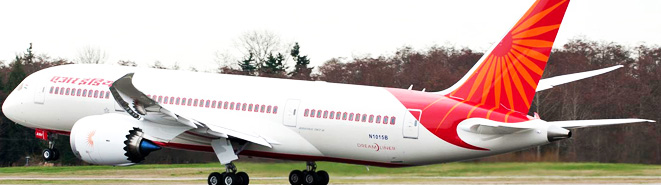 (Dreamliner image-courtesy AI)
“The Boeing 787 Dreamliner is an incredible technological achievement – one that sets a new standard for innovation,” exuded U.S. Transportation Secretary Ray LaHood on 26th August 2011.
On that day, Federal Aviation Administration (FAA) approved production of Boeing 787 Dreamliner with similar self-congratulatory claims that turned out to be unrealistic.
FAA stated it had issued production certificate to Boeing “following a rigorous review by FAA inspectors of Boeing’s quality system, production tooling, manufacturing processes and controls, inspection methods, and supplier control procedures.”
FAA added: “The engineers, inspectors and flight test pilots all worked diligently to ensure our high safety standards were met.”
How dubious these claims have turned out can be gauged from the plight of Air India, one of the biggest customers for the Dreamliner. It is anybody’s guess whether FAA has accessed records of both AI and Boeing on the AI’s nightmarish experience of taking delivery of Dreamliners from Boeing and their subsequent commercial flights.
Records show that Boeing has tried to pacify AI by issuing a letter, amending the Dreamliner Purchase Agreement to account for serious snags in main landing gear (MLG) seals delivery system of the aircraft.
Agenda for Rahul Gandhi-Narendra Modi debate
- Published on 16 February 2014


The Congress Vice-President Rahul Gandhi has repeatedly ducked the issue of debating directly the national issues with BJP’s prime ministerial prospect Narendra Modi.
Mr. Gandhi, take it easy. You can debate without sharing the podium with Mr. Modi. Both of them can give their considered opinion on the core issues, which they have so far largely avoided in their speeches.
They deserve a break from competitive populism which they practice in abundance. For a change, they can shift gears from peddling dreams to meeting grave challenges faced by the country.
They should not shy away from taking a forthright stand on issues that remain unresolved even 67 years after the Independence. They must suggest specific means to resolve these issues.
Certain core issues that have so far not figured in the political babble are: 1) population control - an issue on which there has been 101% consensus in Parliament and which had even frightened eminent healthcare experts even under the British rule; 2) advocacy, enlargement and enforcement of 11 fundamental duties of the citizens listed in the Indian Constitution; 3) ushering in civil code as proposed by the Constitution instead of deepening the religious and caste divides through vote-bank politics including caste census; 4) implementation of reforms recommended by The National Commission to Review the Working of the Constitution (NCRWC) and 5) colossal deficit in the implementation of the Right to Information (RTI) Act in the domain of public welfare.
In this column, a serious attempt has been made to set the eternal agenda for peace and development by drafting questions for both the prime ministerial prospects. Certain questions are specifically addressed either to Mr. Gandhi or to Mr. Modi. Other questions are common for both of them.
Madam Soniaji, please check facts & take back your RTI brag
- Published on 31 January 2014
 “We are the Party that is responsible for the historic RTI Act. We pursued this because we believe that ultimately in transparency lies the solution to the problem. The RTI Act is the single most important reason why citizens of our country feel empowered to fight corruption,” stated Congress President Sonia Gandhi at AICC meeting held on 17th January 2014.
This patently wrong claim has been made on earlier occasions too by various stalwarts of the Congress party and the UPA. RTI is thus becoming yet another example of modern history being distorted through orchestrated disinformation.
The fact is that Congress Party is not the first entity that either ushered in or struggled for the Right to Information (RTI) / Freedom of Information (FOI) legislation. The credit on this count should go to all entities across the political spectrum that pitched for this transparency initiative over the last several decades.
The credit for being prime-mover of transparency legislation should perhaps go to late G. C. Bhattacharya of Democratic Socialist Party, who had moved The Freedom of Information Bill, 1983 in Rajya Sabha way back in December 1983, when Soniaji had not entered politics.