

- Created on Wednesday, 17 June 2015 02:28
- Hits: 5546


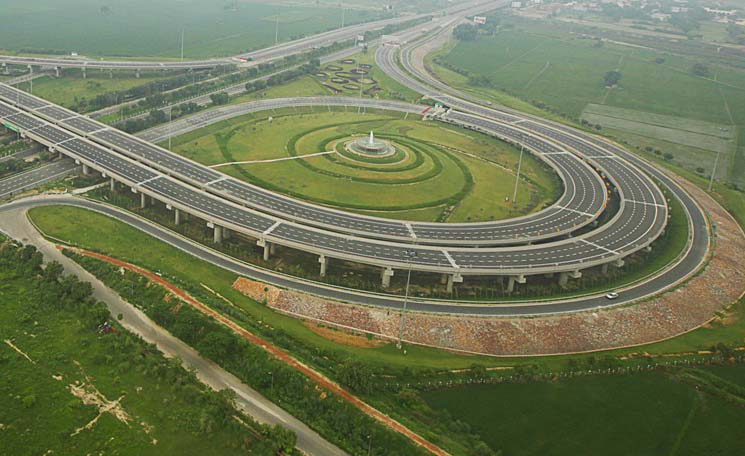 (Yamuna Expressway- Image Courtesy: Jaypee Group)
Greater Noida to get a realty boost with FAB and heliport
Jaiprakash Associates Limited (JAL)-led semiconductor consortium intends to create a dedicated line for defence applications at its wafer fabrication (FAB) project whose groundbreaking is expected in September 2016.
In its pre-feasibility report (PFR) submitted to Government last week, JAL says the Rs 28,919-crore facility would “provide a secured location for the production of semiconductor products to meet India’s security needs (trusted line).”
JAL would have 80% equity participation in the project. The principal technology provider, International Business Machines of the US, intends to have 10% stake. Similarly, 2nd technology partner identified as ‘Principle Integrator’, Tower Semiconductor Limited (TowerJazz), intends to have 10% stake in the special purpose vehicle (SPV) that would promote the venture.
The project would be developed on a 50-acre plot at a prime real estate named Jaypee Greens near Yamuna Expressway in Greater Noida in Uttar Pradesh. The facility would have a capacity to produce 40,000 wafer starts per month (WSPM). It would include a gas-based 80-MW captive power plant.
The JV would implement the project in two phases. Under the first phase, the company would create capacity for production of 20,000 WSPM. It would slice silicon ingots into wafers of 300 millimetre (mm) diameter, which is at present the largest size adopted by FABs globally. The facility would be based on advanced complementary metal-oxide semiconductor (CMOS) technology that helps microelectronics firms produce low power-consuming integrated circuits (ICs).
Under Phase I that is expected to be commissioned in August 2019, SPV would deploy three technology nodes – 90 nanometre (nm), 65 nm and 45 nm. Node indicates the extent of miniaturisation and density of circuits or the ever-shrinking size of different elements embedded on the chips.
As put by PFR, “the factory will be capable of producing a wide variety of technologies. We will adjust the relative mix of the technologies in a very dynamic fashion based on the market needs.”
PFR says: “IBM expects all of the phase I techniques to carry to more advanced nodes, thus helping facilitate the India FAB to come up the learning curve on many of the advanced techniques and act as a catalyst for indigenous development of advanced semiconductor industry.”
It adds: IBM would “integrate Jaypee into an existing ecosystem established by IBM- to facilitate and keep the SPV informed regarding IBM’s technology offerings.” IBM would also provide SPV support in semiconductor R&D, design and packaging of chips.
Apart from defence sector, the FAB would manufacture products for telecommunications including mobile handsets, consumer electronics and many application specific integrated circuits (ASICs) for different users.
Under phase II that is slated for start up in August 2021, SPV would ramp up its capacity to 40,000 WSPM and incorporate enhanced miniaturization technology down to 28nm node. TowerJazz would help SPV manage the FAB. Its listed role includes: “manufacturing readiness & automation; technology qualification and calibration and foundry establishment (design, support customer interface and sales).”
Specifying the rationale and benefits of its project, PFR says the FAB would “provide a sustainable catalyst for electronics manufacturing and starting an ecosystem for potentially providing millions of jobs.”
It would also help reduce the country’s dependence on imports, thereby saving foreign exchange and aiding national security.
PFR explains: “There is the market spill-over effect due to the productivity gains made possible by the FAB on other industries. The combined effect of these factors has been estimated (GDP growth multiplier) to be in the range of 21-23 times the original expenditure in the FAB, over the next 10 years.”
The project would enrich microelectronics manufacturing and human resources ambience as it would be located in Noida-Greater Noida region. It has several fabless semiconductor firms such as ST microelectronics, Atrenta, Sasken Communication Technologies, Freescale, Interra Systems, Cadence, Motorola and many IT firms that include Wipro and Mentor Graphics.
PFR says: “Hence the availability of complementary industries and companies along with academic institutions will enable creation of the right conditions for innovations.”
The project would meet its water requirements by drawing about 11,600 cubic metres/day of raw water from river Yamuna. FAB intends to discharge of 6000 cubic metres/day of treated effluents to the river.
In March 2014, the Government had issued a letter of intent to the consortium after its selection through a global competitive selection process. The Government intends to provide support to selected FAB project under its Modified Special Incentive Package Scheme (M-SIPS) Policy notified in July 2012.
The special incentives listed under M-SIPS include Government reimbursing up to 25% of the capital expenditure on FAB, providing 25% subsidy on growth capital expenditure and provision of interest-free loan under the concept of viability gap funding.
The tax sops to be offered to FABs include reimbursement of excise duty on its products for 10 years and 200% deduction of R&D expenditure under Income Tax Act.
Heliport
The hi-tech profile of the Noida-Greater Noida would get a leg-up from the heliport proposed to be set up at a 13-acre site opposite Gautam Budh University in Greater Noida. RITES Ltd, a public sector enterprise, last month submitted a ‘modified detailed project report’ (MDPR) on heliport to project proponent, Greater Noida Industrial Development Authority (GNIDA).
The heliport cost is estimated at Rs 63.19 crore for 2018, the year in which project is expected to completed. It would provide independent helicopter operations from Greater Noida to Delhi, Lucknow, Agra, Jaipur and other parts of the country.
Though the traffic study has estimated “sizable demand” for helicopter services, the project has been dubbed as financially unviable.
According to MDPR, “the project is not financially viable by itself as projected IRR (internal rate of return) is less than the cost of funds.”
To make the project viable, at least 50% of capital cost has to come as support from outside the domain of project developer. This can be reduced to 40% if the authorities agree to waive off land lease charges.
MDPR says: “another option to make project financially viable is to charge User Development Fee (UDF). The project is financially viable at UDF of Rs. 400 without any capital support. The minimum UDF required to make the project financially viable without any capital support is Rs. 350 in case land lease charges are waived off.”
Notwithstanding this limitation, GNIDA last week initiated the process of securing different approvals for the project.
